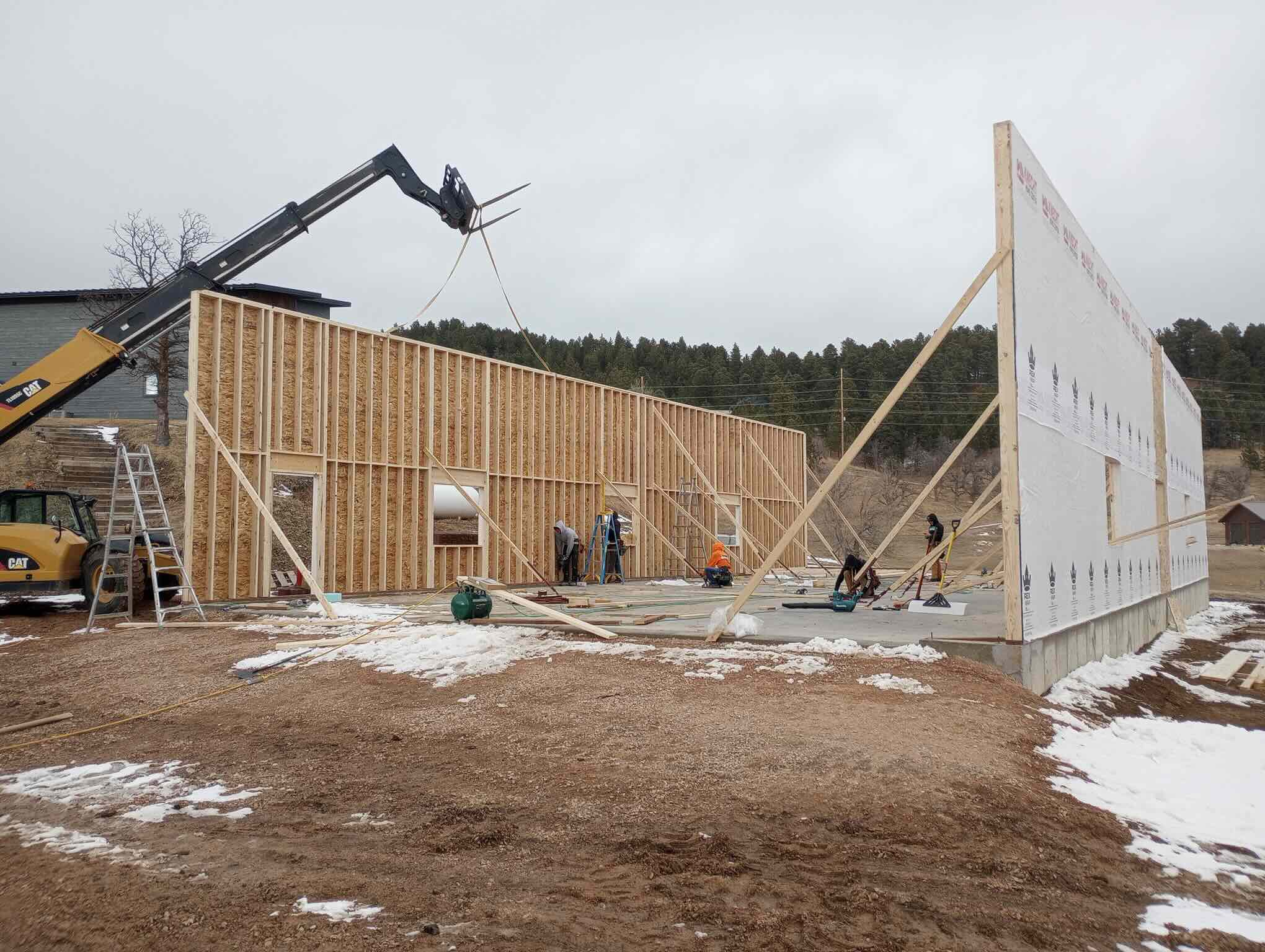
A guide for executives, landowners, and investors building or relocating in low-tax states
Where you build matters as much as what you build. The state you choose to construct a luxury or custom home determines how much of your wealth stays in your pocket before you break ground, during construction, and every year you own the home. A $1.5 million custom home in Wyoming carries a fundamentally different financial profile than the same structure in Illinois or New York. The tax environment is a line item in your build budget whether you plan for it or not.
According to the Tax Foundation, nine of the top ten most tax-competitive states in the country have eliminated personal income tax entirely. Wyoming and South Dakota both rank in that top tier. Both states also sit on opposite sides of the Black Hills, the same mountain range where iLevel Construction LLC builds fully engineered, preconstruction-first custom homes.
This article covers the tax picture across high-build-demand states, what it means for luxury home construction budgets, how state tax climate intersects with property ownership as a wealth strategy, and why the Black Hills region deserves a serious look from out-of-state buyers.
Part 1: The Tax Landscape Across Key States
The CNBC Best Places to Own a Home Report identified that state and local tax burden is one of the top three variables in real long-term homeownership cost. The report found that states without income tax gave high-net-worth homeowners a compounding advantage the longer they held the property.
The difference is not subtle. A household earning $400,000 per year in California owes up to 13.3% in state income tax. The same household in Wyoming owes zero. Over a ten-year window, that gap funds the majority of a custom home build.
State-by-State Tax Snapshot
The table below compares income tax, corporate tax, and estimated effective property tax burden across key states where demand for luxury custom home builds is highest.
| State | Income Tax | Corp Tax | Est. Property Tax Rate | Avg Effective Tax Burden | Build-Friendly? |
|---|---|---|---|---|---|
| Wyoming | None | None | 0.57% | Very Low | Yes |
| South Dakota | None | None | 1.14% | Low | Yes |
| Texas | None | Franchise Tax | 1.60% | Moderate | Partial |
| Florida | None | 5.5% | 0.83% | Low-Moderate | Partial |
| Montana | 5.9% | 6.75% | 0.74% | Moderate | Partial |
| Tennessee | None* | 6.5% | 0.67% | Low-Moderate | Partial |
| Colorado | 4.4% | 4.4% | 0.51% | Moderate | Partial |
| California | 13.3% | 8.84% | 0.75% | High | No |
| New York | 10.9% | 7.25% | 1.72% | Very High | No |
| Illinois | 4.95% | 9.5% | 2.27% | High | No |
*Tennessee eliminated its Hall income tax on investment income in 2021. Sources: Tax Foundation State Tax Climate Index; WalletHub Property Tax by State.
Wyoming: The Benchmark
Wyoming holds the most favorable tax position in the country for high-net-worth individuals. No personal income tax. No corporate income tax. Property tax rates average 0.57% of assessed value, among the lowest in the country per the Lincoln Institute of Land Policy. Wyoming also has no estate or inheritance tax, which matters significantly for families treating real property as generational wealth.
The Black Hills region of Wyoming, including communities near Sundance, Hulett, and the Devils Tower corridor, offers all of these tax advantages alongside genuine land value, limited development density, and a construction environment where your home is not competing for subcontractor schedules with 500 other active projects.
South Dakota: Same Mountain Range, Same Tax Philosophy
South Dakota matches Wyoming on the income tax front. There is no state income tax and no corporate income tax. South Dakota ranks second on the Tax Foundation’s 2024 State Business Tax Climate Index. Property taxes run slightly higher than Wyoming at a state average near 1.14%, but remain well below national average, and the Rapid City/Black Hills area specifically sits below the state mean.
This is the market iLevel Construction operates in. Spearfish, Sturgis, Belle Fourche, Whitewood, Lead, Deadwood. Black Hills South Dakota is a geographic convergence of favorable tax law, genuine land, and a custom home market that remains undersupplied relative to out-of-state demand.
States to Watch: Texas, Florida, Montana
Texas and Florida both eliminate income tax but carry trade-offs. Texas property tax rates average 1.60%, which on a $1.2 million home means roughly $19,200 per year in annual property tax. Florida fares better at 0.83%, per WalletHub’s property tax data, but both states face rapid cost appreciation in their primary luxury markets, which erodes the net tax advantage over time.
Montana offers scenic mountain builds but levies a 5.9% state income tax and 6.75% corporate rate. For business owners and executives, this is a meaningful hit. A 2019 CNBC analysis of total homeowner tax burden found that when income tax and property tax are combined, Montana’s effective burden falls closer to moderate-cost states than its western neighbor Wyoming.
Part 2: How State Tax Climate Affects the Custom Home Build Budget
The cost to build a luxury home is not just what your contractor charges. It includes every dollar your state takes from you before, during, and after construction.
According to Pacaso’s analysis of luxury home construction costs, the average cost to build a luxury custom home in the United States ranges from $500 per square foot on the low end to over $1,500 per square foot for fully custom high-spec builds. A 4,000-square-foot home at $600 per square foot puts you at $2.4 million in hard construction cost before land, design, or site work.
In a zero-income-tax state, the capital you deploy into that build is not first taxed at 9 or 13 percent at the state level. For a business owner or executive pulling $500,000 to fund a build in a given year, that difference is $45,000 to $65,000 in preserved capital. That is a real line item.
Material Costs Are the Same Everywhere. Labor Markets Are Not.
A Reddit thread on the cheapest states to build your own home collected crowd-sourced data from owner-builders and found that labor costs vary far more than material costs between regions. High-density metro markets in California, Colorado, and the Pacific Northwest saw subcontractor premiums 40 to 60 percent above rural mountain west markets for the same scope of work.
The Black Hills sits in a labor market that is not inflated by coastal cost-of-living pressure. Subcontractors based in Rapid City, Sturgis, and Spearfish do not carry Bay Area or Denver overhead. The result is that a custom home built at the same quality standard costs less per square foot in the Black Hills than in comparable destination markets, and that savings is compounded by the favorable tax environment.
Property Tax as an Ongoing Ownership Cost
The Houzz community discussion on designing new construction homes for low property taxes surfaces an important point: design decisions at preconstruction directly affect assessed value, and assessed value drives your annual property tax bill for the life of the home.
Finished square footage, attached garage square footage, outbuildings, and amenity selections all feed into how county assessors value a new build. In South Dakota, where property is assessed at 85% of market value and taxed at an effective rate well below 1% in most Black Hills counties, a $1.5 million home carries a tax bill under $10,000 per year. In Illinois, the same structure triggers $25,000 to $30,000 annually.
Over a 20-year ownership horizon, that is a difference of $300,000 to $400,000 in total property tax paid. Not including income tax saved on the capital that funded the build.
No Sales Tax on Construction Materials in Wyoming
Wyoming does not levy sales tax on construction materials incorporated into real property. South Dakota does, but at a 4.5% base rate with no local add-on in most rural counties, compared to 10-plus percent combined rates in major metro markets. For a $2 million build with $800,000 in material costs, this is a five-figure line item difference.
Part 3: Luxury Custom Homes as an Investment Vehicle
A luxury custom home in the right market is not just a residence. It is a capital asset with appreciation potential, estate planning utility, and tax treatment advantages that stack with the underlying state tax climate. Butera Designs identifies three primary ways a luxury custom home functions as a sound investment: forced appreciation through quality construction, customization that commands premium resale pricing, and land value appreciation in supply-constrained markets.
Forced Appreciation Through Engineering Quality
A fully engineered custom home depreciates structurally at a far slower rate than a spec build. Systems are sized correctly the first time. Envelopes are designed for the specific site and climate. Structural elements are not value-engineered for margin. This extends the performance life of the home and protects resale value at the high end of the market where buyers at this price point can see the difference.
The iLevel process begins with a mandatory preconstruction phase that replaces allowance estimates with real subcontractor bids. Every system is specified before construction begins. The construction proposal is organized by CSI MasterFormat division, the same documentation framework used on commercial and infrastructure projects. This approach produces homes that are built correctly once, with no major unknowns by the time ground breaks.
Land Scarcity in Destination Markets
The Black Hills is a finite geography. There is a fixed supply of buildable land with mountain views, timber, and proximity to recreation. That supply constraint does not reverse. Butera Designs notes that luxury homes in supply-constrained scenic markets have historically held value through real estate cycles better than comparable homes in suburban subdivisions, where supply can always be added.
Out-of-state buyers from Denver, Dallas, and Chicago have driven steady demand for Black Hills property over the past decade. Remote work flexibility has accelerated that trend. A custom home built at the right spec and in the right location enters a market with structural tailwinds.
Estate and Generational Wealth Strategy
Wyoming has no estate tax and no inheritance tax. South Dakota has neither. At the federal level, real property in these states passes to heirs with a stepped-up cost basis, eliminating capital gains on appreciation during the decedent’s lifetime. For high-net-worth families using real estate as part of a broader wealth transfer strategy, this treatment is material.
This is the intersection where the Tax Foundation’s analysis of state estate tax burdens becomes directly relevant to the build decision. Choosing Wyoming or South Dakota as the state of record for a significant real property asset has estate planning implications that should be part of the original location conversation with your advisor.
Rental and Income Potential
Luxury custom homes in destination markets generate short-term rental income at rates that can produce real returns. A high-spec Black Hills home with 4+ bedrooms, a finished walkout, and proximity to Deadwood, Spearfish Canyon, or the Mickelson Trail commands premium nightly rates during peak seasons. Wyoming and South Dakota do not levy state income tax on that rental income.
Combine that with federal depreciation treatment on investment properties, and a second home or investment property in the Black Hills produces a more favorable total return profile than comparable assets in high-tax states.
Part 4: What the Right Builder Adds to the Investment Equation
A luxury home is only as good as the preconstruction process behind it. A builder who skips that phase is not saving you money. He is deferring your risk into the construction phase, where it costs three times as much to fix.
Tax climate determines your starting position. The builder determines whether you protect it. A custom home built with allowance estimates instead of real bids can run 15 to 25 percent over initial budget. On a $1.5 million project, that is a $225,000 to $375,000 exposure that erases most of the state tax advantage you selected the location to capture.
The preconstruction process at iLevel is a working phase, not a waiting phase. It runs 2 to 6 months, costs 1% of the estimated budget, and concludes with a formal construction proposal organized by CSI MasterFormat. Every subcontractor on every division has been bid. There are no allowance-based line items. The number you sign is the number the project is built to.
Cost-Plus Transparency Protects the Asset
The iLevel construction contract is cost-plus, meaning the client pays actual construction costs plus a fixed 10% builder fee. Every draw comes with full documentation. Every change order requires written approval before work proceeds. The client has complete line-item visibility into where every dollar goes.
For an out-of-state executive managing a build remotely, this model is not optional. It is the only structure that gives you real oversight without being on-site. This is why the iLevel technology stack includes Ressio for client portal and daily logs, 3D Vista for virtual as-built scans with walls open, and Starlink Roam for connectivity on remote Black Hills sites.
Target Completion Within 12 Months From Groundbreaking
Extended construction timelines carry real cost. Carrying costs on construction financing, inflation in material prices, delayed occupancy. iLevel targets completion within 12 months from groundbreaking. The preconstruction investment is what makes that timeline realistic. By the time ground breaks, the project is fully designed, fully bid, and fully scheduled. The job site does not run on uncertainty.
Part 5: Why the Black Hills Specifically
Most destination real estate markets that combine scenic value and low-tax state policy are priced accordingly. Teton County, Wyoming has no income tax, but entry-level land for a custom build runs well into seven figures. The cost advantage is consumed by land price before the first subcontractor is called.
The Black Hills offers an alternative. The combination of scenic mountain terrain, low population density, and a construction market that has not yet been fully discovered by out-of-state capital means land prices remain accessible relative to comparable mountain west markets. You are not paying for the reputation of the market yet. You are buying into the fundamentals.
iLevel Construction serves the Black Hills region across both states. South Dakota build locations include Spearfish, Sturgis, Belle Fourche, Whitewood, Lead, Deadwood, and surrounding communities. Wyoming build locations include the Sundance, Hulett, Aladdin, and Devils Tower corridor. The process is the same in both states: engineered preconstruction, real bids, fixed-fee cost-plus, and a 12-month target from groundbreaking.
Frequently Asked Questions
Does it make financial sense to relocate to Wyoming or South Dakota specifically to build a luxury home?
For high-income earners in states with 8 to 13 percent income tax rates, the answer is often yes, depending on overall financial structure. The CNBC homeownership tax analysis found that combining no-income-tax domicile with low-property-tax real estate produced the largest long-term homeownership cost advantage of any variable studied. This is a conversation to have with your tax advisor before committing to a location, not after.
How does state tax policy interact with federal treatment of luxury real estate?
State taxes and federal taxes operate independently. Federal mortgage interest deduction, federal depreciation on investment properties, and federal capital gains treatment on primary residences all apply regardless of state. But state income tax directly affects the net after-tax cost of capital you use to fund a build. In Wyoming or South Dakota, that capital is not taxed at the state level. The Tax Foundation’s full breakdown of state vs. federal tax interaction is worth reviewing for a complete picture.
What should I look for in a builder to protect the investment value of a custom home?
The most important variable is preconstruction process. A builder who replaces allowance estimates with real subcontractor bids before contract signing protects your budget and timeline. A builder who uses allowances is pricing convenience for himself and transferring risk to you. The iLevel preconstruction process is documented publicly and runs before any construction contract is signed. Review what your builder does before ground breaks, not after.
Are there design decisions that lower assessed value and reduce annual property taxes?
Yes. Houzz community data on designing for lower property taxes identifies finished square footage, accessory structure choices, and specific amenity selections as the primary levers. In states where assessment follows market value closely, every finished square foot carries a tax cost. An experienced builder can advise on where quality investment produces disproportionate livability value relative to assessed value impact.
The Bottom Line
Where you build is a financial decision before it is an architectural one. State tax climate determines how much of your capital reaches the job site, how much you pay annually to own the asset, and how much your estate retains when you transfer it. Wyoming and South Dakota are not just scenic alternatives to overbuilt mountain markets. They are the two states that most directly preserve the capital you invest in a custom home, from the day you fund the project to the day your heirs inherit it.
If you are an executive or business owner looking at a luxury custom home build in the Black Hills, the financial case for this specific region is not incidental. It is structural. The tax environment, the land market, and the construction infrastructure are aligned in a way that does not exist in most destination markets.
Talk to iLevel Construction about the preconstruction process. The first step is understanding exactly what you are building and what it will cost before you commit to a contract. That conversation starts with preconstruction. It does not start with a shovel in the ground.
Sources and Citations
Tax Foundation 2024 State Business Tax Climate Index | CNBC Best Places to Own a Home and Pay Fewer Taxes (2019) | Pacaso: Cost to Build a Luxury Home
Houzz: How to Design a New Construction Home for Low Taxes | Butera Designs: 3 Ways a Luxury Custom Home Is a Good Investment | Reddit: Cheapest Place to Live and Build Your Own Home
Lincoln Institute: 50-State Property Tax Comparison Study | WalletHub: Property Taxes by State | iLevel Construction LLC